Minimally invasive cases rarely walk through the door. Most of the time, I build them.
Dentists tell me they never get no-prep cases. I understand. Most of the time, I’m the one who creates the space and the position that makes a no-prep case possible, and that always starts with moving teeth. Pre-restorative orthodontics isn’t an add-on to these cases. It’s the case.
This patient is a good example. His wife thought his teeth looked like little chiclet teeth, and she asked if I could just give him a bunch of veneers. She wasn’t wrong. His teeth were healthy and he had almost no dentistry, just a few shallow composites. But the fronts were boxy and small, and they were wearing down.
He also had a reverse smile curve, mild crowding on the lower, and a two-step occlusion. The lower anteriors sat higher than the lower posteriors.
Start With the Question, Not the Plan
Before I wrote a treatment plan, I asked what I wanted each arch to look like. Dr. John Kois taught us to break the arches apart. It’s harder than it sounds. Upper arch on its own: lengthen the front teeth and soften that reverse curve. Lower arch on its own: lose the two-step.
Intrude or Overlay
There are two ways to level that lower arch. You can bring the lower posteriors up with overlays, or you can intrude the lower anteriors. Overlays meant four teeth on each side, eight in total. That’s additive and conservative, and a member on the session made that exact case. I told her she wasn’t wrong.
I intruded the lower anteriors with Invisalign. It meant less restorative dentistry, and the video backed it up. When he talked, his six lower front teeth stuck up in his mouth. The front was too high. The back wasn’t too low.
That’s why I record video before I plan anything. Patients smile for the mirror and tell me nobody sees that when they talk. The video usually disagrees.
I don’t always make that call. If his upper arch had been virgin teeth needing the vertical opened, I’d have left the lower anteriors alone and added overlays to the lower posteriors. And the reason is this: opening the vertical on the upper means covering the lingual cusps, and you can’t do that without reducing cusp tips. On the lower, the overlay wraps the buccal cusp tip, the facial wall, and the occlusal table, so you stay additive.
How Far Out Do You Move Them
On the 12 o’clock view after Invisalign, his canines sat exactly on the wet-dry line of the lip. His centrals and laterals were still behind it. Here’s the thing: that’s where I wanted them. If I had pushed the incisors all the way to the lip line, I couldn’t have placed a veneer without cutting tooth structure back.
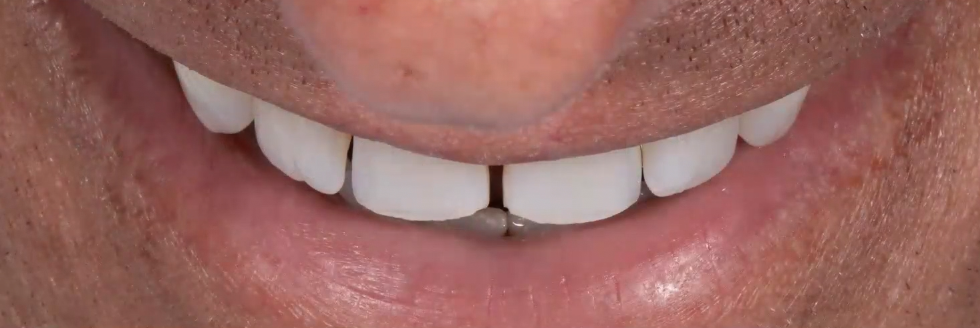
That’s why I started doing my own Invisalign. Orthodontists would sometimes deliver the teeth to the perfect finishing position, and then I had to reduce the tooth to make room for porcelain.
Here’s the pearl: move the teeth far enough to make room for the veneer, and stop there.
The Spacing I’d Change
I used Invisalign Express 10 on this case, which I almost never do now. He was a friend, his teeth looked straight, I was early in my Invisalign experience, and I only pushed them out. That’s where I missed.
I want two-thirds of the space on the mesial of the lateral and one-third on the distal. He finished with the reverse. A reversed ratio gives you a bell-shaped lateral with the zenith tipped to the wrong spot, and no amount of shaping fully fixes it. I trimmed the provisional at the neck to slim the lateral. Aaron Johnson of CMR tapered the neck on the ceramics. The lateral still reads a little full.
There were two fixes I didn’t use. I could have done more Invisalign so the laterals moved distally, which is what I’d do today.
And I could have bonded a little convexity onto the mesial of his canines. That closes down the space beside the lateral without moving a tooth. My head was on keeping four veneers prepless, and a member on the session saw it before I did.
The Prep and the Provisionals
The prep looked like his natural teeth because it nearly was. I use an incisal edge matrix, and where the distal incisal edge of #8 touched it, I knew that corner needed a disc. That left at least 0.5 to 0.75 mm for ceramic. I opened the interproximal contacts just enough for a path of draw, rounded the sharp line angles, and stayed in enamel.
Thin preps need thin provisionals, and thin provisionals need to hold. I spot etch closer to the cervical margin, brush only Part 2 of a fourth generation bonding agent over the whole prep, blow it thin, cure it, and shrink wrap with bisacryl. An ultra-thin Cosmedent disc reopens the incisal embrasures.
Before every prep like this, my assistant sees the patient for 15 minutes, a week or two days ahead, when he’s not numb. He gets a clear Essix retainer and learns what to do if a provisional breaks. No pain, tray back in, call us Monday.
Aaron made the ceramics in monolithic e.max lithium disilicate, stained, not cut back, because they’re so thin. I seated them under a custom dam and cleaned the margins with an ET3 carbide, which cuts the resin and leaves the porcelain alone.
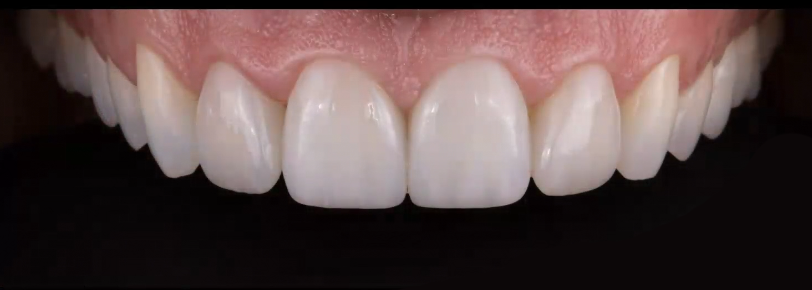
This case is from 2012. I’ve been pulling older cases from my archive to see what I’d do differently, and this one gave me a list.
The case looked good at delivery. It taught me more when I went back and asked what I’d change.
What We Covered in This Discussion
- How to pitch orthodontics to a patient who only wants veneers: a composite mock-up to the length they want, then a bite that shows the length isn’t possible without moving other teeth
- Treating each arch on its own, then choosing between intruding the lower anteriors and eight lower posterior overlays, and why opening the vertical on virgin upper teeth flips that answer
- Why video of the patient speaking, or a shush or Duchenne smile, shows lip dynamics a mirror smile hides, and how it drove the decision to intrude the lower anteriors
- Reading the 12 o’clock view against the wet-dry line of the lip to decide how far to move the incisors, plus how to position the patient for the photo
- Why two-thirds of the space belongs on the mesial of the lateral, what a reversed ratio does, and the fixes: more Invisalign, canine convexity, or leaving peg lateral space and bonding to ideal width first
- Using an incisal edge matrix with depth cuts to leave at least 0.5 to 0.75 mm of ceramic at the distal incisal edge of #8, opening contacts for a path of draw, and staying in enamel
- Bonding thin bisacryl provisionals with spot etch and Part 2 adhesive only, then shrink wrapping, and a 15-minute pre-op visit so a broken provisional becomes a Monday call
- Shade communication for thin veneers: showing the lab the canines and laterals as well as the temporaries, with polarized photography or eLAB for four or fewer teeth
- Delivery under a custom dam: dry provisional removal, water try-in for color, Teflon tape before the clamps, tack curing, and an ET3 carbide for margins because it cuts resin and not porcelain
- What an older case teaches: why eight teeth beats six on a six-veneer case, how porcelain and composite combine, and how CMR retrieves archived designs after seven years