
Veneer Workflow: From Risks to Results
Risk to result — every step of the case
 Dr. Amanda Seay
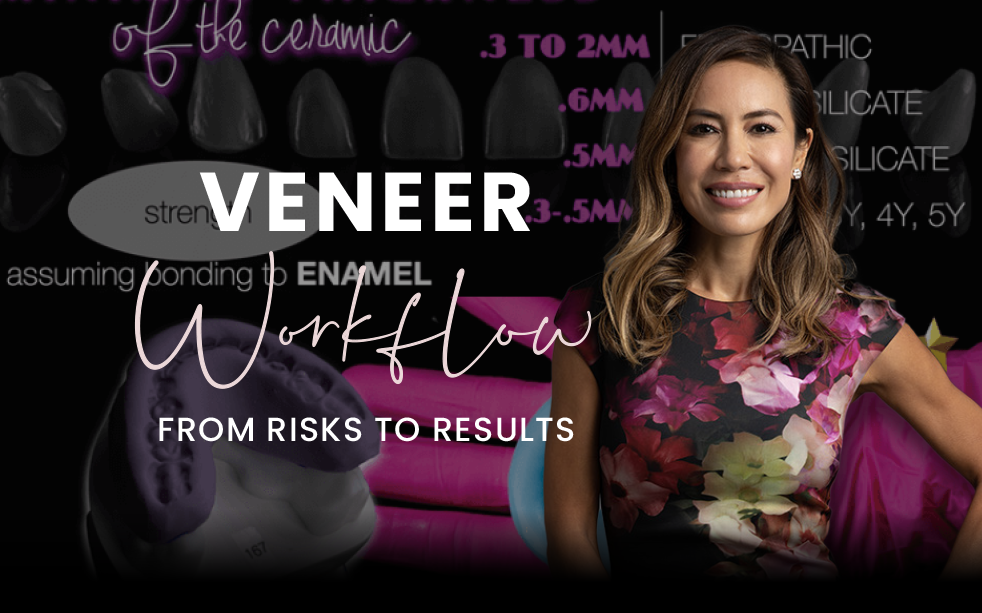
This course series provides a step-by-step guide to mastering veneer cases, covering every phase from risk assessment and tooth preparation to final smile design.
Learn how to evaluate patient risk, follow systematic prep workflows, capture precise impressions, select the right materials, implement effective checklists, and design harmonious, beautiful smiles. With practical insights and proven techniques, this series supports predictable outcomes and long-term success.
You’ll Walk Away With
- How to assess patient-specific risk factors and make treatment choices that protect long-term outcomes
- A step-by-step prep sequence that aligns clinical execution with final case goals
- Techniques for analog impressions and provisionalization that support tissue health and esthetics
- How to select the right material for each case, balancing strength and beauty
- The power of checklists to enhance efficiency and reduce oversight in every case
- A holistic approach to smile design, integrating facial, dental and gingival esthetics
Who This Course Is For
General and cosmetic dentists building consistent veneer outcomes. Best for clinicians who already have foundational restorative experience and want to systematize their approach to veneer cases.
$1,627
One-Time Purchase
- 6 Modules · 4 Hours
- 4 CE Credits
- Yours to Keep
- Watch Anytime

Curriculum
Patient's Risk
Preview
Understanding a patient's risk factors is critical when developing a treatment plan. The treatment choices we make should never increase a patient's risk but instead aim to improve or, at the very least, maintain their current risk level. When you approach patient care with this perspective, every decision contributes to a predictable, long-term prognosis and favorable outcomes.
- Apply the known bone-and-tissue measurements that take veneer decisions out of the emotional realm and into predictable prognosis
- Manage risk deliberately when it can't be eliminated — across enamel vs. dentin, prep design, and bonding substrate
- Rule things out first — the inflammation that wasn't the veneers
Prep Sequence
Preview
When it comes to tooth preparation, it is essential to follow a systematic workflow with the final result always in mind. In other words, we must begin with the end in mind before picking up the handpiece and irreversibly removing healthy tooth structure. This module will guide you through the entire preparation process, from initial planning to achieving the final preparation.
- Keep occlusal contacts entirely on porcelain or entirely on tooth — never on the margin junction where marginal breakdown accelerates
- Match every prep shade to the adjacent teeth so porcelain thickness and color stay controllable
- Reduce only where the tooth sits outside the final design, with orthodontics considered before the handpiece
Impressions & Provisionalization
Preview
While it may seem like the easiest part of a preparation appointment, the final impression and provisionalization are actually the most critical—and often misunderstood—steps in the process. There are various methods to capture the final impression, ranging from analog to digital techniques. This module covers analog techniques that simplify and streamline the process, making appointments more predictable. Additionally, we'll discuss the best provisionalization techniques to ensure beautiful, healthy tissue throughout the duration of the provisional phase.
- Use the double-cord technique and warmed hemostatic paste — the composite-warmer pearl that changes how it flows
- Skip the upper tray for upper teeth — buccal-lingual compression drives material into the sulcus
- Finish with high polish without glaze, and the clear Essix that turns weekend breakage into a Monday visit
Materials
Preview
Choosing the right dental material for veneer cases can be overwhelming given the wide range of options available today. It is essential to understand how the selected material influences tooth preparation and when to prioritize physical strength over esthetics.
- Weigh flexural strength vs. fracture toughness — and why toughness matters more when choosing veneer materials
- Understand why material choice matters less on enamel — an enamel-bonded veneer restores natural-tooth strength — and much more in dentin
- Plan for retreatability, dark substrates, uniform color across different prep positions, and custom pink-porcelain shade tabs from your own lab
Records & Checklists
Preview
In clinical dentistry, there are numerous opportunities for steps to be missed, mistakes to occur, or important questions to be overlooked. Implementing a systematic checklist helps ensure that even the most basic tasks are completed consistently and accurately. This module introduces a records checklist that can be integrated into every veneer case to improve efficiency and outcomes.
- Capture every scan, photo, and data point the same way, every case
- Redefine workflows as digital tools multiply the ways to communicate
- Build a written guide that lets any team member run the records appointment
Smile Design
Preview
Before treating a case, we must first envision the ideal outcome from a smile design perspective. All elements of smile design—face, teeth, and tissue—should be evaluated as a cohesive whole. By analyzing each category individually and then integrating them, we can achieve a final result that is truly beautiful and harmonious.
- Evaluate lips and gingival architecture separately from tooth form, then integrate them
- Build mock-ups that let the patient define the goal, not the textbook
- Design for incisal edge harmony, axial inclinations, embrasure spaces, central dominance, and buccal corridors
Want the entire course collection?
Best ValueAll 5 On-Demand Courses · Yours to Keep
Stay current
New tips, case discussions, and course news as they release — straight from Amanda.
Unsubscribe anytime.